


Wood Bar Countertops: Best Hardwood Choices for Bars, Restaurants, and Homes
18 May 2026
Farmhouse Wood Countertops: Warmth, Grain, and Natural Character
10 June 2026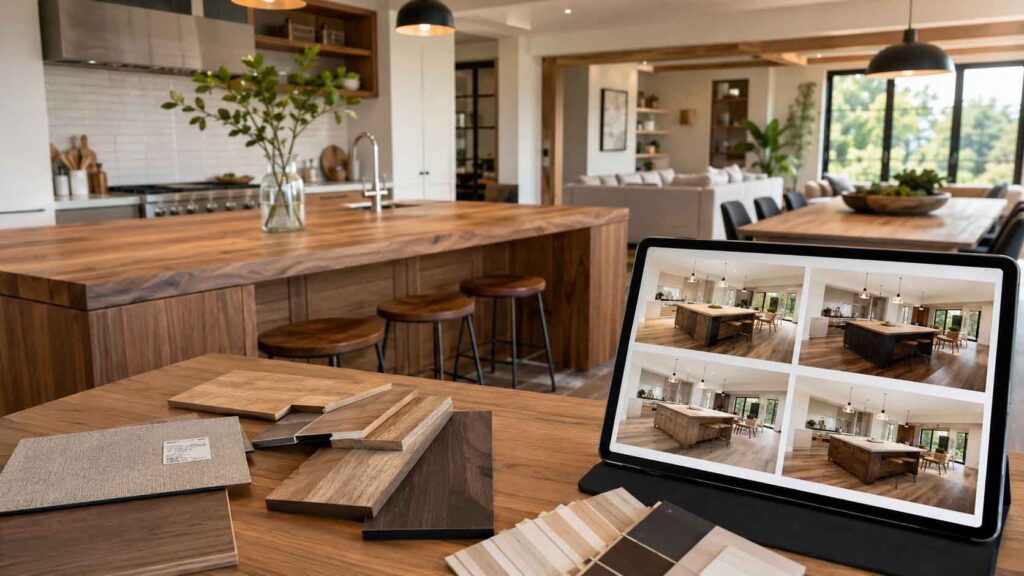
AI home visualization before final finishes is becoming a useful tool for homeowners who want to make clearer decisions before choosing materials, colors, countertops and wood surfaces. It does not replace the designer, the builder, the fabricator or the real material. But it can help people see the direction of a home more clearly before they invest.
Final finishes are often difficult to imagine from small samples. A hardwood countertop may look warm and beautiful on a table, but feel completely different when placed across a full kitchen island. A darker wood tone may look elegant in a showroom, but too heavy in a smaller space. A lighter surface may brighten a kitchen, but may need contrast from cabinets, flooring or lighting.
This is where AI visualization can become helpful. It allows homeowners to compare different visual directions before making a final choice.
Why final finishes are hard to choose
When people plan a home, they often look at small samples: a piece of wood, a cabinet door, a flooring board, a stone sample or a paint color. These samples are useful, but they do not always show how the full room will feel.
A finish changes when it is seen in a larger surface. Wood has grain, movement, tone and natural variation. Light also changes everything. The same countertop can look warmer in natural light, darker under artificial light or more dramatic next to neutral cabinets.
That is why many homeowners struggle to imagine the final result. They are not only choosing a material. They are choosing the atmosphere of the home.
AI does not replace real materials
It is important to be realistic. AI visualization should not be treated as a perfect prediction of the final result. Real hardwood has natural grain, texture, variation and finish behavior that depend on the actual material, fabrication and installation.
But AI can still be useful because it helps with comparison. A homeowner can see different directions side by side: lighter wood, darker wood, warmer tones, cleaner modern finishes or a more natural rustic look.
In other words, AI does not replace the real countertop or the real finish. It helps the homeowner imagine the home more clearly before choosing final materials.
How AI helps compare wood surfaces
Wood surfaces have a strong visual impact inside a home. A hardwood countertop, kitchen island, dining surface or built-in wood feature can change the entire feeling of a room.
AI can help homeowners compare several options before they commit. For example, a warm natural wood countertop may make a kitchen feel welcoming and comfortable. A darker hardwood surface may bring depth and elegance. A lighter tone may create a calm, open and modern feeling.
These differences can be difficult to understand from a single sample. But when the options are placed into a kitchen or open living space, the decision becomes easier to discuss.
The countertop should be seen in the whole room
A countertop is not an isolated object. It has to work with cabinets, flooring, backsplash, wall color, lighting, hardware and the general style of the home.
This is especially important with hardwood countertops because wood brings warmth and character into the space. If the wood tone is too close to the floor, the room may feel flat. If it is too dark for the available light, the kitchen may feel heavier than expected. If the grain is too strong, it may become the main visual feature of the room.
For homeowners who want to look more specifically at countertop styles, tones and wood surface options, related examples can also be explored through Wood Countertops, where the focus is closer to kitchen surfaces and countertop choices.
AI helps homeowners ask better questions
The biggest value of AI visualization is not that it gives one perfect answer. The value is that it helps homeowners ask better questions before buying.
Is this wood tone too warm for the cabinets? Does the countertop need more contrast? Should the room feel more rustic or more modern? Will a darker island make the kitchen feel more elegant or too heavy? Does the flooring work with the countertop, or do the tones fight each other?
When these questions appear before the final decision, the homeowner has a better chance of choosing a finish that fits the whole space.
Where Ruwana fits into visual planning
For AI-based visual simulations, design direction testing and image production, platforms such as Ruwana Studio Production can help turn an idea into a visual reference that is easier to compare and discuss.
This does not mean that the generated image becomes a technical plan. It means that the conversation becomes more concrete. Instead of relying only on imagination, the homeowner can see possible directions and understand what feels right before moving forward.
What still needs to be confirmed in real life
Even when AI visualization is useful, the final decision must still be connected to the real material. With hardwood countertops and wood finishes, the species, grain, thickness, finish, durability, maintenance and fabrication details all matter.
Samples are still important. Measurements are still important. Professional advice is still important. AI can help guide the visual direction, but the final result depends on the real wood and the quality of the work.
That difference matters. A generated image can help a homeowner understand a direction, but the final countertop has to be selected, built and installed correctly.
A clearer decision before investing
Final finishes are among the most visible decisions in a home. Countertops, flooring, stairs, cabinetry and wood surfaces are not small details. They shape how the home feels every day.
That is why clarity before investing is valuable. AI visualization can help reduce uncertainty, compare several options and make the design conversation more practical.
The goal is not to let AI decide. The goal is to help the homeowner see more clearly before spending money on materials and finishes.
Conclusion
AI does not replace real hardwood, real craftsmanship or professional guidance. But it can help homeowners visualize wood surfaces, countertop tones and interior design directions before choosing final finishes.
When planning a home, the question is not only “Do I like this sample?” The better question is: “Do I like how this material will feel inside my home?”
AI can help make that question easier to answer before the final decision is made.


